The Great Ocean Road is one of Australia’s most famous road trips, and after exploring it twice, I can understand why. Dramatic cliffs, huge beaches, rainforest walks and koalas casually hanging out in the trees – there’s a lot to pull over for.
For our longer trip, we hired a campervan in Melbourne and spent a week travelling along the coast to Port Fairy and back. And while the Twelve Apostles were obviously on the list, some of my favourite moments were the ones in between: walking among towering Californian redwoods, spotting wildlife and making a sanga in the van with a view of the waves.
And if you’re wondering what a sanga is, my Australia travel tips guide covers a few words worth learning before you go, along with plenty of other useful things to know.
This 7-day Great Ocean Road itinerary follows our actual campervan trip, including the stops we made, where we stayed, which campervan we rented and the best time to go, plus practical tips for life on the road. It includes a direct inland drive back to Melbourne on Day 7. We actually booked our van for seven nights, giving us an extra day to return along the coast and drop it off on Day 8 – I’ll explain both options below.
You can follow it by car too – just book accommodation along the way, whether that’s a hotel, an apartment or a cabin at one of the holiday parks.
A little warning, though: we fitted quite a lot into those days. So treat this as a route you can adapt, rather than a checklist you have to finish. If you’d rather spend longer on a beach and inspect fewer rocks, I won’t judge.
A second little warning: this is going to be a long blog post. Sorry about that, but I’m putting all my Great Ocean Road knowledge in here.
Before you hit the road, here are a few essentials to help you plan your trip.
Before you go
Where to Stay
Book campervan sites directly with the parks linked below. For hotels, apartments and some holiday park cabins, check Booking.com.
Stay Connected
Get online from the moment you land with Saily eSIM. I use it on most of my trips to avoid hunting for a local SIM card. Get yours now.
Pay like a local
I use Wise to pay in local currency and avoid huge bank fees while travelling. Sign up for Wise and pay like a local.
Drink tap water
Drink clean water wherever you go with a Waterwell filter bottle – My travel essential for years. Order yours here.
Travel with peace of mind
Don’t forget travel insurance before your trip. I use SafetyWing whenever I travel abroad. Protect yourself with SafetyWing
Protect your data
Using public WiFi at airports, cafes or hotels? I use NordVPN to keep my connection and my personal data safe. Check out NordVPN
Want more tips like these? Check out my full Travel Resources page for everything I use to plan and book trips.
Now, a few practical things to know before you hit the road.
Planning your Great Ocean Road trip
Before we get into the daily route, there are a few things worth sorting out: when to go, what to drive and where you’re going to sleep. Here’s what to know before setting off from Melbourne.
When is the best time to visit the Great Ocean Road?
Autumn (March–May) and spring (September–November) are good options if you want to explore outside the main summer rush. Autumn brings cooler days for walks and sightseeing, while spring is another option if you don’t mind some changeable weather.
Summer (December–February) offers warmer weather and longer days, but expect more company, especially during the Christmas and January holidays, when accommodation and campervan hire can also get quite expensive. Easter is another busy period, so don’t assume an autumn trip automatically means quiet campsites and empty viewpoints. If you’re travelling in a campervan, it can get pretty hot inside too.
Winter (June–August) can still be worth considering for dramatic coastal scenery and fewer crowds, but shorter days and colder, wetter weather need a bit more planning. Especially when your bedroom is a van.

Both of my Great Ocean Road trips were around late March and early April, with our seven-day campervan trip running from 28 March to 4 April. The weather was changeable, with a few cloudy days and a bit of rain. We even went back to a few places, including the Twelve Apostles, to get photos with blue sky. But in general, I can recommend this period.
Great Ocean Road by campervan or car?
You can follow this Great Ocean Road itinerary in either a campervan or a car. I’ve tried both: a campervan for the full seven-day trip and a car for a shorter weekend visit.
Travelling the Great Ocean Road in a campervan was a bucket-list item for me, so that decision was pretty much made before we started planning. Having the kitchen and the bedroom with us meant we could make food when we wanted and eat with a view of the ocean. Which, honestly, was a pretty big part of the appeal.
A car is a good option if you prefer something smaller to drive and a proper room at the end of the day. You can stay in hotels, apartments or cabins at holiday parks, including some of the parks we used on this trip.
Search for places to stay along the Great Ocean Road on Booking.com.
I wouldn’t automatically assume a campervan will work out cheaper. Compare the hire, insurance, fuel and campsite costs with the price of a car and accommodation for your dates. Then decide how much you like the idea of turning your bedroom into a kitchen every morning.
Hiring a campervan for the Great Ocean Road
There are loads of campervan hire companies in Australia, including Apollo, Maui, Britz, JUCY and Travellers Autobarn. Which one you choose will depend on your needs – how many people are travelling, how much space you want and what facilities you need, but, let’s be honest, probably mostly your budget.
We rented a Kuga campervan from Travellers Autobarn, which worked well for the two of us. I’ve actually rented from them twice, also for a road trip in Western Australia. Their vans are nothing fancy or particularly special, but they do the job and have the equipment you need for cooking and sleeping.
The Kuga has a small kitchen with a gas cooker, fridge, microwave and sink, plus cooking equipment and bedding. It’s also automatic, which makes driving a van on unfamiliar roads a bit easier.
When you collect the van, you’ll get a full introduction to how everything works, including the gas, water and setting up the bed. So don’t worry if you haven’t travelled in a campervan before – you’re not expected to magically know how to operate your new home on wheels.
I’ve also tried JUCY in Queensland, and between the two, I’d pick Travellers Autobarn. Although, to be fair, our JUCY van was older, which may have influenced that opinion.
Pro tip:
If you want to make your van feel a bit more homey, get some fairy lights and a light-coloured blanket to throw over the seats or bed. A couple of small touches and suddenly your rental van feels like your own little home.
Important tip:
Before booking your campervan, check what the rental cover includes, how much excess you’d pay if there’s damage and which roads you’re allowed to drive on. For your own travel medical cover, you can check out SafetyWing’s travel insurance plans.
I recommend SafetyWing
Where can you stay overnight in a campervan?
Unfortunately you can’t simply park beside a beach on the Great Ocean Road and settle in for the night. Being allowed to park somewhere during the day doesn’t automatically mean you can sleep there. As a general rule, stay in a designated campground or an area where overnight stays are explicitly allowed. You’ll often see signs saying “No camping” or “No overnight stays”, but the absence of a sign doesn’t automatically mean sleeping there is allowed and the fines apply. Rules vary along the route, so check locally before settling in for the night.
You have 2 main options: basic bush campgrounds and holiday parks.
Bush campgrounds are the more back-to-nature option – what you might think of as “wild” campsites, although these are still established camping areas. Many have basic toilets, often non-flush ones, but don’t expect showers, electricity or drinking water. Some are free and first come, first served; others require booking and payment. Check that your chosen campground accepts campervans, as some sites are for tents only.
Holiday parks usually offer powered sites, unpowered sites or both. A powered site lets you plug your van into electricity; an unpowered site doesn’t. You’ll generally have shared toilets, hot showers and a camp kitchen, and many parks also have washing machines and dryers, usually for an extra charge.
Budget roughly AUD 40–80 per site per night outside peak periods, depending on the park, your dates, the number of people and whether you want power. That isn’t a maximum, though. Popular parks and holiday dates can cost considerably more – even up to AUD 200 per spot in peak season.
We most often stayed at BIG4 holiday parks. I’ll include the places we stayed in the day-by-day itinerary below, so you can see what fits your route. Book ahead if you’re travelling during summer holidays, Easter or long weekends.
Pro tip:
Check your van’s length before booking campsites. Some holiday parks ask for its dimensions or whether it’s above or below a certain size, so they can allocate a suitable spot.
Everything takes longer in a campervan
Getting dressed, cooking, washing up, finding that one thing you packed away somewhere – everyday tasks take a bit longer when you’re living in a van. Space is limited, things need moving out of the way, and everything has to be secured again before you drive off. Then there’s also filling up with water and petrol, emptying waste and all the other little jobs that come with travelling with your house.
So if you see a day with only 30 km of driving and think you could fit in more – well, of course you can – it’s your trip. But just allow time for daily life in the van as well as driving and sightseeing. Those short distances don’t necessarily mean you’ll be sitting around wondering what to do.
Driving basics
In Australia, you drive on the left, and you’ll see plenty of signs reminding you along the way. Minimize driving after dark and and plan sunset stops close to your overnight stay. At sunset, kangaroos and other wildlife start becoming more active. I drove at night a few times and honestly found it horrible – you never know what might jump out of the bushes. Hitting an animal in your rental car or van is definitely not a memory you want from this trip. Wildlife can appear during the day too, so always stay alert.
A few final practical tips:
- download offline maps before setting off – sometimes you might not have reception;
- bring layers and waterproofs;
- check current access notices for the attractions, particularly beach steps, and tide/surf conditions before going onto beaches. They might be closed.
Day 1: Melbourne to Anglesea – 118 km
It’s the first day, so we’re taking it easy: pick up your campervan, stock up on food and get on the road. Allow some time for the collection and van instructions before heading out of Melbourne.
Stop in Torquay to do your food shopping for the trip, then continue towards Anglesea. Today is mostly about settling into your new home on wheels, so there’s no need to squeeze in too much sightseeing.
Stops along the way
- Point Addis Lookout – your first proper stop for coastal views.
- Anglesea Beach – finish the day with a beach walk around sunset.
Where we stayed
Day 2: Anglesea to Apollo Bay – 72 km
This is your first full day exploring the Great Ocean Road, with coastal views, a lighthouse, coffee stops and hopefully some wildlife. Start with breakfast in the van at a beachside car park – this is exactly why you brought your kitchen with you.
Stops along the way
Split Point Lighthouse, Aireys Inlet
Walk up to the lighthouse and explore the nearby lookouts. If you fancy a slower start, stop at The Lighthouse Tea Rooms for tea and something to eat.
Great Ocean Road Memorial Arch
A photo here is practically compulsory. There’s a dedicated spot for taking pictures beside the road, so use it rather than standing in the street. In other words, don’t follow my example.
Lorne
Lorne is a small but pleasant seaside town, with a big grassy foreshore full of cockatoos leading down to the beach, plenty of food options and surf shops to browse.
Stop at Moons Licensed Espresso Bar for coffee and a bite to eat, or grab some fries from The Salty Dog Fish & Chippery. The place doesn’t look like much, but the fries were good. Although, honestly, everything tastes better on a road trip. Keep an eye on your food, though – the cockies will happily help themselves.
Teddy’s Lookout
Stop at Teddy’s Lookout for views of the coast, the Saint George River and the Great Ocean Road winding around the hillside.
Kennett River
Stop here to look for wild koalas and kangaroos. We’ve visited twice: the first time, we spotted koalas and some kangaroos; the second time, neither.
Look carefully, especially up in the trees – koalas are surprisingly difficult to spot. There are no guarantees, but that’s part of the fun: these animals are in the wild, doing their own thing.
Where we stayed
Day 3: Apollo Bay to Port Campbell – 105 km
Start with a coffee from LittleCrumb Bakery in Apollo Bay, then get ready for a change of scenery. Today, we’re heading inland into the Otways, swapping coastal views for tall trees, ferns and winding forest roads.
The drive through the forest is a lovely part of the day in itself, although the roads are very winding, so take it slowly and drive carefully. It rained a little during our visit, but having lunch in the van with that smell of forest in the rain was one of those moments when I was very happy we’d hired a campervan.
Stops along the way
The Redwoods, Otways
These towering Californian redwoods were planted in 1936 as an experiment, and today you can walk beneath them beside the Aire River. It’s a peaceful place to wander and appreciate just how small you are next to those trees.
For directions, search for “The Redwoods Otways” near Beech Forest in Google Maps.
If you fancy a waterfall stop too, Hopetoun Falls is only a short drive from the Redwoods, while Beauchamp Falls and Triplet Falls are other options to explore in the surrounding Otways.
Port Campbell
After the forest, head back towards the coast and settle into Port Campbell. Grab something to eat at 12 Rocks Beach Bar Cafe, overlooking the bay, or finish the day with a drink and sea views at Barrels Bar. Preferably once the van is parked up for the night.
Little tip
On the way to Port Campbell, you’ll reach some of the Great Ocean Road’s most iconic scenery around the Twelve Apostles. We’ll explore this stretch and its viewpoints tomorrow, but if you’re passing around sunset and the sky looks promising, stop at Gibson Steps to enjoy the evening light along the coast.
Where we stayed
Port Campbell Recreation Reserve Campground
Day 4: Port Campbell to Peterborough – the Twelve Apostles area – 25 km
This is the day. The towering cliffs, limestone stacks and wild ocean views – the scenery you probably pictured when you first started planning your Great Ocean Road trip.
Start with a coffee at Grassroots Deli Cafe in Port Campbell, then head out to explore. There’ll be a bit of driving backwards and forwards today (so you’ll probably do more than 25 km), especially if you’re chasing better weather or sunset light. But this stretch is worth revisiting. I should know – I practically know the road between Port Campbell and Gibson Steps by heart.
Stops along the way
Twelve Apostles
The most iconic sight on the Great Ocean Road deserves some time. Walk between the viewpoints and take it all in: those huge limestone stacks standing in the ocean, with waves crashing around them. If the weather isn’t playing along, having time in this area gives you another chance to come back.
The Bakers Oven
This little bay was a lovely spot to park the van and have lunch with a coastal view and there was nobody else there when we visited.
The access is via a narrow dirt track, so check the conditions and your rental agreement before turning off. Some companies explicitly advise against dirt/unsealed roads and warn about loss of cover. We made it in our van, but if you’re uncomfortable taking yours down there, skip it.
Loch Ard Gorge, The Razorback and Thunder Cave
Explore the walking tracks and viewpoints around Loch Ard Gorge, including The Razorback lookout and Thunder Cave. There’s history here too: the gorge is named after the Loch Ard, a ship wrecked nearby in 1878 with only two survivors. Follow the shipwreck trail towards the cemetery, with information boards telling the story along the way.
London Bridge and The Grotto
Two more stops worth making as you head towards Peterborough. London Bridge is another impressive offshore rock formation, while The Grotto offers a different perspective through a natural rock arch.
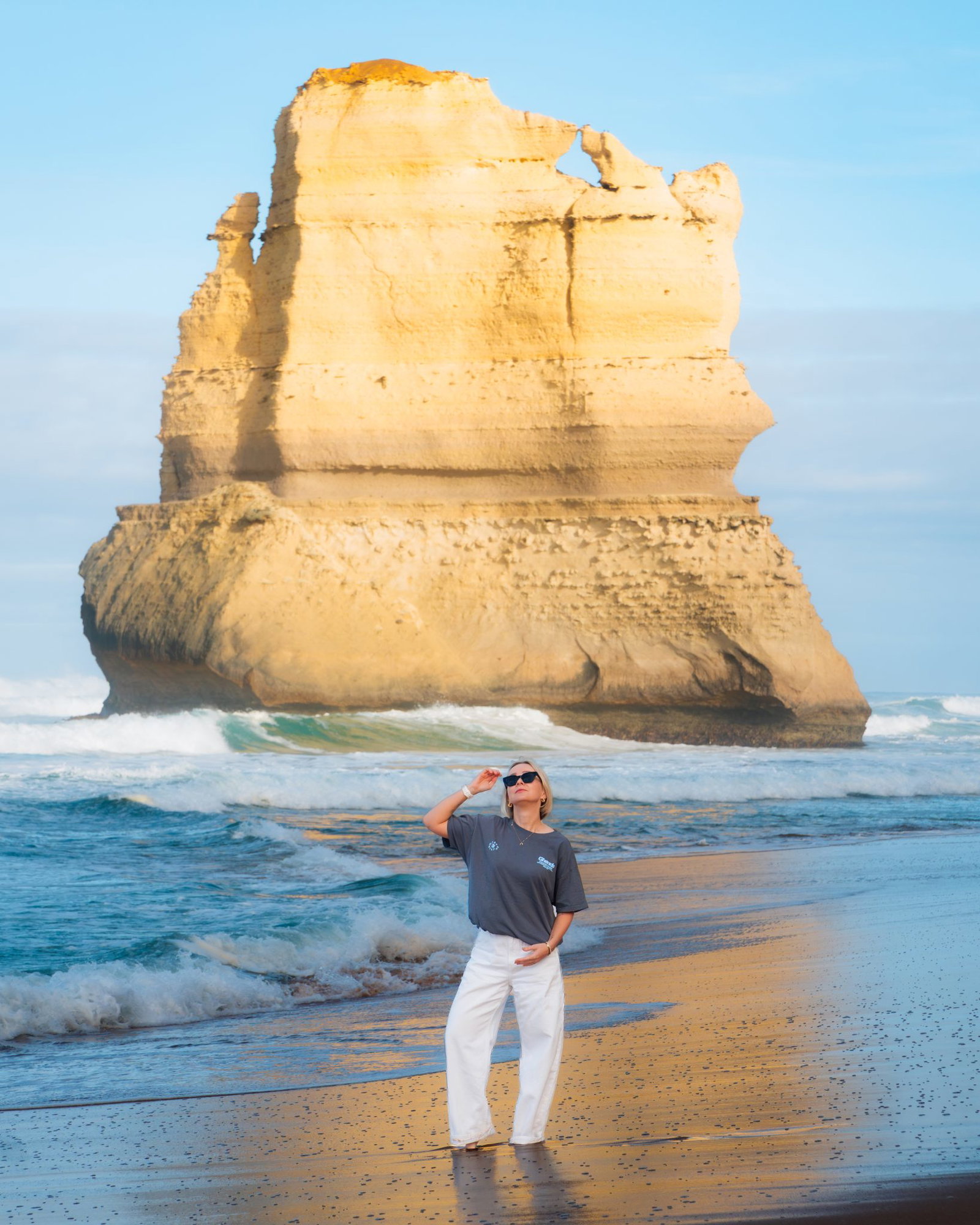
Gibson Steps – sunset
If you didn’t stop here yesterday, or fancy another visit, save Gibson Steps for sunset, when conditions allow beach access.
Getting a photo here with the sun peeking out from behind the rock became a bit of an obsession for me. Because of the weather, I didn’t manage it on my first Great Ocean Road trip, and only finally got it on the last day of my second visit. So yes, I’ve been here approximately a million times. Was it worth all the driving back and forth? Absolutely.
Important info!
Watch your step: I’ve spotted snakes at both Gibson Steps and London Bridge – one at each, on separate visits. They like basking in the sun, so keep an eye on where you’re walking, especially on sunny days. Stick to the marked paths, and if you see a snake, don’t panic and give it plenty of space. It doesn’t want to be near you either.
Where we stayed
Great Ocean Road Tourist Park, Peterborough.
Day 5: Peterborough to Warrnambool – 55 km
After yesterday’s sightseeing, today you can take it a little easier. Start with a walk on Peterborough Beach, then continue west towards Warrnambool, stopping wherever takes your fancy.
If the weather wasn’t cooperating yesterday, you can also head back to any sights you want another look at before moving on. Otherwise, it’s a day for coastal viewpoints and beach stops, hopefully with some sunshine.
Stops along the way
- Bay of Martyrs – another lovely stop for rugged coastal views.
- Bay of Islands – more limestone stacks scattered across the ocean.
- The Great Ship lookout – squeeze in another coastal viewpoint, if you haven’t had your fill yet.
- Childers Cove – take a detour to this sheltered-looking cove surrounded by cliffs and rock formations.
There are other beaches along this stretch too, so leave yourself some time to stop if the weather is nice. Then continue to Warrnambool, your destination for the night.
Where we stayed
Warrnambool Surfside Holiday Park
Day 6: Warrnambool to Port Fairy via Tower Hill – 31 km
Start the day with coffee at Rough Diamond (a must!) and a brekkie sanga from Day Kitty, then head out for a day of wildlife spotting and exploring Port Fairy.
Stops along the way
Tower Hill Wildlife Reserve
Set inside a dormant volcano, Tower Hill is a change from the beaches and coastal cliffs. Follow the walking tracks and keep an eye out for koalas, kangaroos and emus. We spotted koalas during our visit and also spent some time painting our own boomerang, which was quite fun. So this stop ended up involving both wildlife spotting and a little arts-and-crafts session.
Port Fairy
After Tower Hill, continue to Port Fairy for a wander around town and along the waterfront. This is the furthest west we went on our trip, so enjoy a slower afternoon before starting the journey back tomorrow.
Where we stayed
Killarney Caravan Park, near Port Fairy.
Day 7: Killarney to Melbourne – approximately 285 km inland
Unfortunately, it’s time to head back to Melbourne. You can stop in Warrnambool for one last coffee at Rough Diamond, but if you’re short on time, get straight on the road.
Unless you want to revisit somewhere along the Great Ocean Road, take the inland route back. Allow around 3.5 hours for the roughly 285 km drive, plus breaks – and check the journey time to your actual rental depot.
How we spent our final day
We actually had the van booked for an extra night, so we took our time heading back along the coast. We revisited Bay of Islands, Lorne and the Memorial Arch, then stayed at BIG4 Anglesea Holiday Park (day 1 holiday park) again.
Then we drove back to Melbourne and returned the van on Day 8. If you have the extra time, this gives you another chance to revisit favourite stops or catch somewhere in better weather.
Leave time before drop-off to clean the van, empty any waste and refuel according to your rental agreement. Packing up your little home on wheels takes longer than simply checking out of a hotel, so don’t plan to arrive at the depot with ten minutes to spare.
Great Ocean Road itinerary FAQs
I don’t think so. A week gives you time for the big coastal sights, a detour into the Otways and a visit to Tower Hill and Port Fairy. It also gives you a bit of wiggle room if the weather doesn’t cooperate. I went back to Gibson Steps more times than I care to admit, so I appreciated having that flexibility.
Yes. If you have three or four days from Melbourne, I’d focus on the stretch from Torquay to Port Campbell. Keep the Memorial Arch, Lorne, the Twelve Apostles and Loch Ard Gorge on your list, then pick either the Otways for a forest stop or Kennett River for a chance to spot koalas. Save Warrnambool and Port Fairy for another trip, and take the inland route back to Melbourne.
Yes. Start with the inland drive from Melbourne to the Port Fairy or Warrnambool area, then follow the coast east back towards Melbourne. Reverse the order of your overnight stays and decide separately when you want to visit the Twelve Apostles and Gibson Steps. If you’re hoping for sunset at Gibson Steps, it’s worth planning that stop around where you’re sleeping that night.
End of the road… for now
I hope you’ve enjoyed this 7-day Great Ocean Road itinerary and found some useful ideas for your own trip. I think it’s a varied route, with time for the famous sights, forest walks, wildlife spotting and a few meals with an ocean view. But of course, you can change things around, skip stops or stay longer wherever you like – it’s your road trip.
Most of all, I hope you have loads of fun and plenty of sunshine. The Great Ocean Road is impressive whatever the weather, but blue skies make everything better. And save you driving back to the same viewpoint approximately seven times.
Enjoy the road, keep an eye out for wildlife and give yourself time to stop just because somewhere looks nice. Those unplanned moments might end up being your favourites.
Hi, it’s Aga, the author of this blog. If you found this blog post interesting, entertaining or useful, please think of buying me a virtual coffee to support the site’s running costs. But if you know me, I might actually spend it on coffee. Thanks!
Pin for later!

Leave a Reply