China is a huge, fascinating and endlessly impressive country. One moment you’re walking through ultra-modern cities with skyline views, high-speed trains, and spotless metro systems; the next you’re surrounded by ancient temples, quiet parks and dramatic mountains. It’s a country of contrasts in the best possible way and one that’s absolutely worth visiting.

Because the country operates in its own unique way, China for first timers often comes with a reputation for being complicated to travel to – and I believed that too. I almost cancelled my trip, convinced it would be more work than pleasure. No internet, no Instagram, and as a vegan… total starvation mode. Turns out, I couldn’t have been more wrong.
Sure, you’ll need a few apps, the Internet might not always behave the way you expect, and some everyday habits are not what you’re used to. But once you know these things in advance, everything becomes surprisingly straightforward.

This “China for First Timers” guide is for travellers who want to arrive prepared and relaxed. I’ll cover the practical things to know before traveling to China – from visas, to apps and connectivity – so by the time you land, you’ll feel ready to enjoy the country rather than figure it out on the go. I’ll also share how to go smoothly through immigration, what Chinese words is useful to know and when you should definitely not visit.
Are you more interested in things that might surprise you when travelling to China? Read my other China blog post. They definitely surprised me!
Intrigued? Let’s go!
China for First Timers: mistakes to avoid and tips to know
Let’s start with the formalities.
Do I need a visa?
That naturally depends on the country your from, but yes – most travellers do need a visa. There is an important exception though, that makes things much easier for many people right now: under China’s expanded travel policy many nationalities are also eligible for visa-free entry into China for up to 30 days. The majority of European countries can enter China visa free until 31st of December 2026.
If your country is is not included in visa free scheme, you’ll most likely have to apply for an L-visa – a tourist visa.
DO CHECK your visa requirements on your country’s governmental website.

How long does immigration take?
Well, that obviously depends on many factors including the airport you’re flying into at the time of your arrival. But I’d say that in general you should reserve from 60 to 90 minutes for going through Chinese immigration.
I arrived at Xi’an airport late at night and assumed that, because it wasn’t Beijing or Shanghai, immigration would be fairly quick. It wasn’t. I still ended up waiting around 90 minutes.
Even though I’m from a visa free country, I was still a little nervous about the immigration process itself. I even had my entire trip planned out and printed — hotel bookings, itinerary, everything – just in case. But when I finally reached the window, it turned out to be much simpler than I’d imagined. I was only asked a couple of basic questions: where I was from and where I was travelling from. Then came the sound of the stamp – and that was it.

The immigration process will be definitely easier if you have the following documents on hand and ready to show:
- a passport valid for at least six months from your date of entry;
- a completed arrival card – you’ll usually receive it during check-in for your flight in your country of origin. It was pretty straight forward;
- a screenshot or print out of your return ticket;
- screenshots or print outs of your hotel bookings.
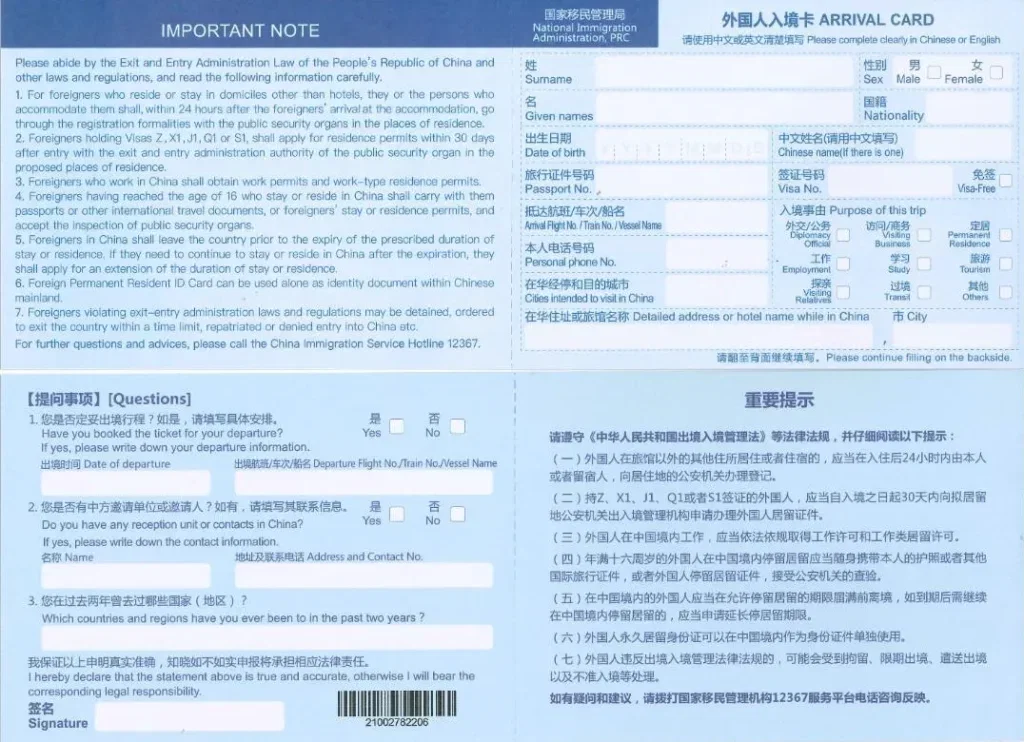
Why screenshots or print outs?
Because even if you quickly enable your eSIM (we’ll talk about it later) the internet connection might be a bit funky. You don’t want to keep the immigration officer waiting while you’re trying to load some websites.
What’s the Chinese currency?
China’s currency is the Chinese Yuan, also known as Renminbi (RMB). Roughly speaking, 1 USD equals about 7–7.5 RMB, and 1 GBP equals around 9–9.5 RMB (rates fluctuate, so this is just for easy mental conversion). In practice, though, you won’t use cash very much in China. I actually didn’t even buy any yuan before travelling to China. 99% of transactions are made digitally via…apps that I’ll talk about now.
No time to read now? Pin for later!

What apps do I need to download?
Ah yes – Chinese apps. That was another “scary” topic for me, but only because I genuinely hate downloading apps and signing up for things. Spoiler alert though: one Chinese app quickly became my favourite app of all time and made me wonder why every country doesn’t offer something this brilliant. I’m talking about…drumroll please…

Alipay
Alipay is China’s most widely used mobile payment and lifestyle app. It’s basically your…everything! Not only does it allow your to pay for things (in shops, cafés, restaurants), but it lets you use metro and buses in many cities, rent city bikes, book taxis (Didi rides), buy train tickets, book accommodation, translate things and…well, that’s it. But isn’t that enough? All of it, in ONE APP! For Chinese citizens Alipay offers even more functions, like paying bills. The only thing you can’t do with Alipay as a foreigner is to order food. In fact there is a different app for that, but it requires having a Chinese phone number. Ok, but I’m just messing with your brain by adding useless information. To sum up, you need to have Alipay!
For first-timers in China, Alipay is especially useful because it works for foreign visitors. You can link an international debit or credit card (Visa, Mastercard, etc.) and start paying without needing a Chinese bank account. And again, since cash in China is pretty much non existent – I don’t even know what Chinese yuan look like – I’ll say it again: you need to have Alipay!
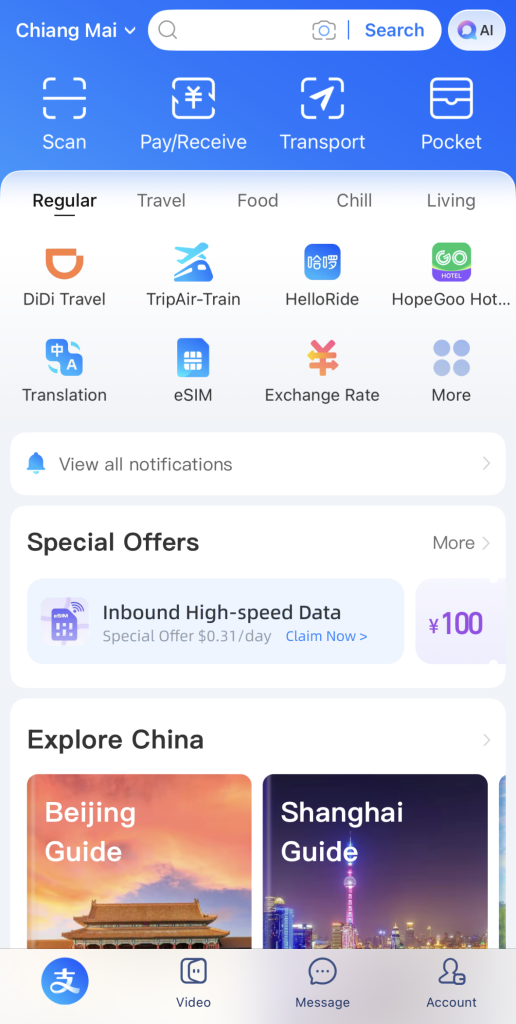
WeChat is China’s all-in-one app and another essential download for traveling in the country. While it’s best known as a messaging app, it’s also widely used for payments, bookings and everyday communication, both with people and businesses. You won’t necessarily use it as much as Alipay as a tourist – I used it mainly to communicate with hotels, but having WeChat installed is still very useful.
While I had no problems with downloading and installing WeChat, some people do struggle with it. Not because they’re doing something wrong, but because of…well…technology. So definitely download and install it before your trip.
Amap
As the name suggests, Amap is a navigation app. A Chinese version of Google maps. While Goggle maps work in China, well…sort of, for precise directions you need Amap. It’s incredibly accurate for walking, public transport and driving directions and it even shows metro exits and travel times.
The only thing I had to get used to was its “looks”. The user interface seemed a bit messy for me. But after a while I forgot about Google maps, because Amap works just perfectly.
A little tip:
When searching for things in Amap, like restaurants, cafés, tourists attractions, it sometimes helps to translate the name from English to Chinese in Google translate, Then copy and paste the Chinese translation into Amap.
You can download all the above mentioned apps from the App Store and Google Play.
Another “app” you need: Wise! Ok, it’s not only an app, it’s a bank account and the best debit card for travellers, but you can easily connect Wise to Alipay and get the best exchange rate on all your transactions. I’ve been using Wise for years, saving a lot of money!

What about Google, Instagram YouTube, Netflix…will they work in China?
Short answer: no.
China uses what’s commonly known as the Great Firewall, which means many Western websites and apps simply don’t work once you arrive. Google, Instagram, WhatsApp, Facebook, Netflix and even Gmail are blocked, so without preparation it can feel like your phone suddenly lives in a different universe.

A little tip:
Well, I actually found Google Chrome to be working, but only if you type the exact name of the website you want to go on. Google search won’t work. You can use other search engines like Bing.
What about the rest? Don’t worry, you’ll be still able to post on Instagram. There are ways to make everything work! How? Keep reading!
How to stay connected in China?
If you want to stay connected and still use your favourite apps, the solution is simple: a VPN and a reliable eSIM. A VPN lets you access blocked sites and apps as you normally would, while an eSIM gives you mobile data that works from the moment you land. The key thing to know is that both should be set up before you enter China, as downloading or activating them after arrival can be difficult or impossible. Once they’re in place, staying online is easy and stress-free.
Which VPN should I use?
Well, that’s a good question. If I wanted to just make money off you, I’d say that the VPN that I’m an affiliate of and I’ve been using for years: NordVPN is a must when travelling through China. Otherwise super reliable, unfortunately in China NordVPN simply didn’t work.
The bigger and the more famous the VPN company is, the more well known it is to China, so they detect it and block it.
Use my special link and get NordVPN anyway to protect your online presence other countries. Good deal guaranteed!

I used Proton VPN and…it did work at first, but after a few days it was kind of useless too. But no worries, I have a solution…
Which eSIM should I use?
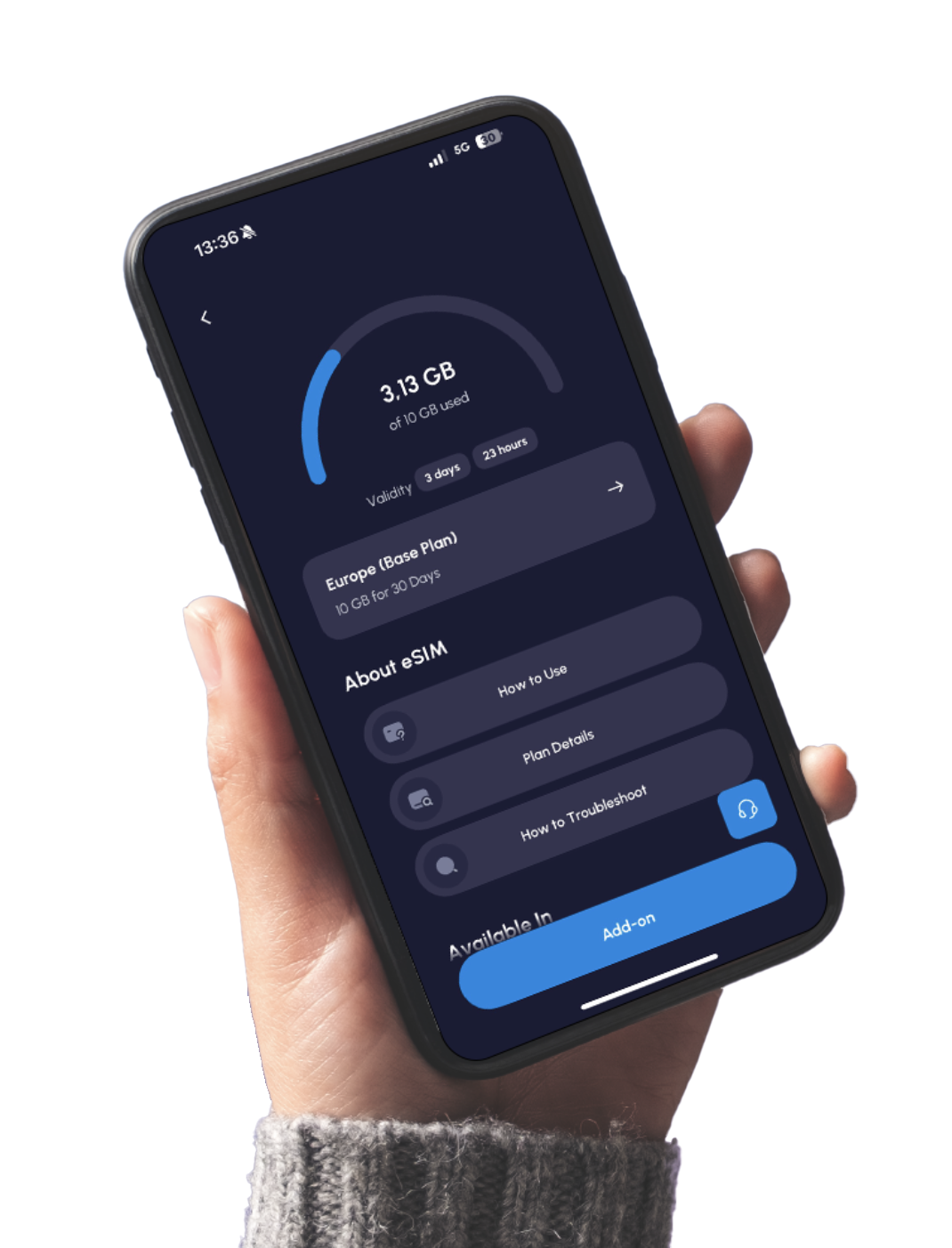
Here, with a clear conscience, I can recommend Nomad eSIM. It’s easy to set up, the prices are reasonable, and most importantly, during my two weeks in China it didn’t let me down even once. It worked perfectly throughout the entire trip. Just again, remember to buy it and set it up before you arrive in China! That’s the key!

Super important tip!
Since VPNs don’t always work reliably, it’s a much better idea to invest in a Nomad eSIM with plenty of data (you can even get up to 90 GB) rather than relying on public Wi-Fi and VPNs. This way, you can easily use your phone as a hotspot for your laptop and, if needed, even watch Netflix without any hassle. I had 20 GB for 2 weeks and it was a sufficient amount. So, if you’re interested, sign up for a Nomad eSIM here.
Ok, we covered the basics of the basics, let’s call them: how to do China”. But I’m sure you still have a lot of questions, like…
When is the best time to Visit China
China is a year-round destination, but when you visit can make a big difference to your experience. Spring (April–May) and autumn (September–October) are generally the best times to travel, with mild temperatures and clearer skies in most regions. Summer can be very hot and humid, especially in big cities, while winter is quieter and colder, but can be great for fewer crowds and lower prices.
I visited China in mid-October and can definitely recommend this time of year. The only surprise was the weather in Xi’an and Beijing, which was colder than I expected – and colder than I’d packed for. If you choose to travel in October, make sure to bring a thicker sweater or a light jacket, especially for the evenings.

Whenever you go, I’m sure you will enjoy your time. Just make sure you avoid a trip there…
When not to go to China?
…during public holidays! What holidays? There are a few during the year, but the two you should absolutely avoid are Chinese New Year (usually falls between late January and mid-February) and National Day Golden Week (from around October 1 to October 7). Well, unless of course you want to experience those festivities. But since during these holidays people travel to visit their families, transportation systems (trains, flights, even highways) are extremely busy, popular attractions are packed and prices for hotels and trains usually go up. Everywhere and everything is simply extremely busy.

So if you’re hoping for a more relaxed, less crowded trip, it’s generally best to plan around these dates. Simply google the Chinese holidays for the year.

You know when to travel, now let’s find out where to travel.
Where to go in China for first timers?
As first-timers in China, it’s a good idea to start with places that are easy to navigate and well connected – remember: China is huge! It’s also good to pick something that combines easy transport, clear sightseeing and a gentle cultural introduction. That’s why the most popular choice is China’s so-called Golden Triangle: Beijing, Xi’an and Shanghai – it’s exactly what I did on my first trip. These cities are linked by fast, efficient high-speed trains, offer a great mix of history and modern China, and make the logistics surprisingly straightforward.

Since I flew to China from Thailand, my closest entry point was Xi’an, so I started there. Then continued to Beijing and finished in my favourite city – Shanghai. It felt like a natural progression, moving from traditional, to a mix of traditional and modern, and finally to super modern. I can definitely recommend doing it in this order, although I know that if you’re flying to China from Europe or the US, you’ll most likely land in Beijing or Shanghai instead.

Where to book accommodation in China?
As a “Westerner” you’re probably used to booking accommodation on Booking.com. While you can still use it to book hotels in China, there’s another platform that is better. It’s called Trip.com. Perhaps you’re familiar with it too? It’s huge, especially in Asia.
Since Trip.com is Chinese, it offers far more variety than most Western booking platforms, not only in term of hotels, but also room types in those hotels. Many local hotels list their rooms on Trip.com first, including smaller boutique places and well-located hotels that don’t always appear elsewhere. Prices are often more competitive too, especially for mid-range and higher-end stays.
The only thing I had to get used to was a different user interface and the fact that sometimes they show prices per night, instead of for a whole stay – it always annoyns me. But otherwise Trip.com works perfectly, which makes it a solid choice for China for first timers looking for good options without overpaying. Ohh and it’s also integrated into Alipay! Yay!
Do I have to carry my passport everywhere when in China?
Short answer: yes!
Depending on how anxious a traveler you are, you might already be used to carrying your passport everywhere – for me, China was the first country where it was genuinely necessary. Apart from security checks that might happen at any point (like before entering metro system), your passport is often your ticket to tourist attractions, as tickets are usually linked directly to your passport number at the time of purchase. When you arrive at the entrance, you don’t scan a paper ticket or a QR code – you simply scan your passport and walk in. It feels a bit unusual at first, but once you get used to it, it’s actually very efficient.

So yes, never leave your hotel room without your passport and keep it safe!
Is China a safe country?
Another short answer: yes, it’s super safe.
China is generally a very safe country to travel to. Violent crime is rare, cities are well monitored, people seemed to be very honest. At one point, I even left my phone a few metres away from me for several minutes to record a video – and after I returned, it was still there. That’s something I definitely wouldn’t do in Europe.

Do people speak English in China?
It will obviously depend on where you go – in Shanghai for example, English is spoken more frequently – but in general, Chinese people don’t speak much English. Even in international hotels, staff may only have very basic English, so it’s worth being prepared for that. That said, communication is rarely a real problem thanks to apps, translations and a lot of patience on both sides. Even my favourite app: Alipay has a translator built in. So I can honestly say that, despite my initial worries, communication wasn’t much of an issue.
You can also try to earn some points by learning basic words in Chinese, like: hello – nǐ hǎo, and thank you – xièxiè (syeh-syeh).

And one small, slightly funny detail: in shops, cafés and restaurants, it’s incredibly common for people to say “bye bye” when you leave. English or not, that part seems universal.
One more thing:
Metro and bus stops were in English too!
Ufff That’s it!
I didn’t cover all the topics I wanted, but this blog post is long enough. Be ready for “China for first timers” part 2. coming up in a few weeks, where I’ll talk more about “day to day” issues and cultural differences.
To wrap things up, I hope this guide helps make China for first timers feel less intimidating and a lot more approachable. With a bit of preparation and the right expectations, traveling in China is not only easy, but genuinely rewarding.
If you’re planning a trip, make sure to check out part two of this blog post, where I’ll go deeper into practical tips that made my trip even smoother.
Last thing, I know I didn’t mention any mistakes to avoid, that was just a little “trick” to lure you into reading my blog post. But honestly, I didn’t make any. Well, maybe apart from not going to China sooner. But I did my research and I was prepared – and now, thanks to my blog post – you will be too!
Hi, it’s Aga, the author of this blog. If you found this blog post interesting, entertaining or useful, please think of buying me a virtual coffee to support the site’s running costs. But if you know me, I might actually spend it on coffee. Thanks!
Pin for later!





Almost cancelling because of no internet, no Instagram, and the fear of starving as a vegan is a very believable first-China panic. The useful surprise is that the country gets much easier once the phone setup is done before the flight.
I would add one boring thing to the pre-arrival list: save the hotel name and address in Chinese as a screenshot. It helps at immigration, in a DiDi, and when the data connection decides to be “a bit funky” at exactly the wrong moment.
oh yes, that’s a smart tip. Thanks!